
Water Quality Management (WQM) is a term that gets thrown around in water and wastewater circles without a lot of explanation or background.
Ask ten water operators what water quality management means, and you’ll get ten answers. Some will say compliance: hit every rule from the state. Some will say treatment: keep the process steady as source water changes. Others will point to the lab, the sampling schedule, the Consumer Confidence Reports (CCRs), or the monthly report. They’re all right. Each one plays a part of it.
And the work has paid off. Since the dawn of the Safe Drinking Water Act (SDWA) and the Clean Water Act (CWA) and subsequent amendments, water stewards everywhere have fought the good fight of improving water quality in drinking and wastewater. NEIWPCC has a neat timeline of advancing clean water here, but the official history of the CWA is cataloged matter-of-factly by the USEPA here but shown below in a graphic as well.
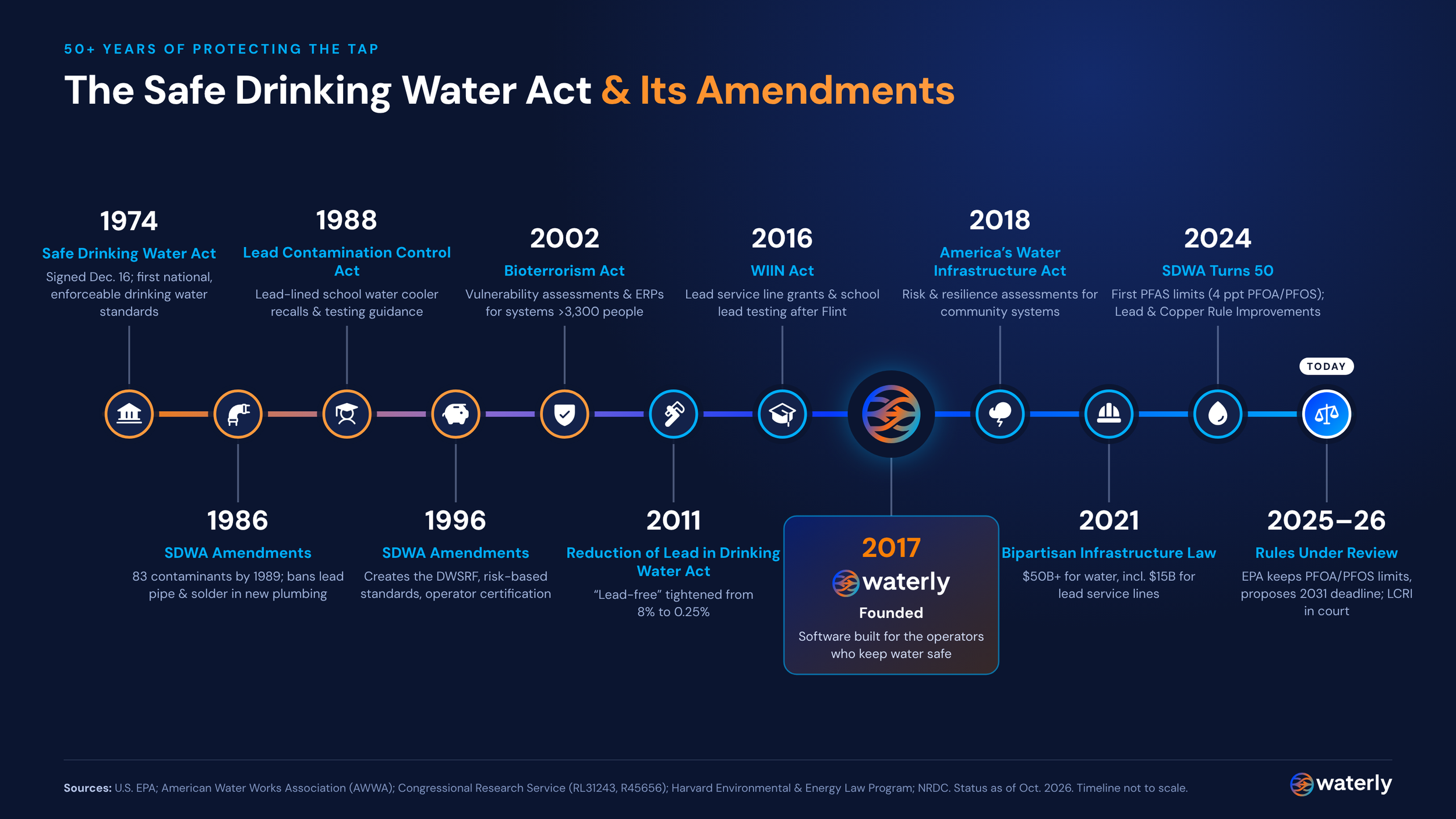
Operators made that happen, and the job covers more than most people see. So what does water quality management include? Let’s start there.
What is water quality management?
Water quality management is the process of stewarding the source, treatment, potable drinking, or wastewater effluent quality of water to meet health and regulatory standards. I think we can start with WQM at that basic level without too much debate.
It's all one big cycle, and for some communities, drinking water source is well-treated wastewater effluent.
For public water and wastewater treatment systems, WQM starts with source water (or pretreatment for wastewater). It also means compliance with USEPA, state, and local water quality guidelines. I think that’s also a fair addition. No one can debate that WQM means meeting or exceeding those regulatory guidelines.
Lastly, there’s stewardship. We can’t treat water to exceed drinking or wastewater effluent standards at any cost. Every system’s operation has costs: hard costs like power and chemicals, softer costs like labor spent treating, and the overall costs of the utility.
That gives us a working definition of Water Quality Management:
Source Water Quality and Quantity Management
Meeting or Exceeding Regulatory Compliance to the Tap or Discharge (for WW)
Achieving #2 above while stewarding water resources well
The Importance of Water Quality
Before we dive into the elements, let’s briefly talk about why operators, water doctors, water quality professionals, and dare I say everyone, should find water quality monitoring and management important. It’s because:
Regulations require it – This is obvious. The Safe Drinking Water Act and Clean Water Act set enforceable water quality standards and discharge permits, and states and local agencies add their own rules. A good process shows you’re meeting them every day, not just on sample day.
It’s good for the Earth - Improved health and safety. Source and receiving waters are shared, and poorly managed treatment or discharge puts nutrients, pathogens, and chemicals into rivers, lakes, and aquifers. A process protects the water you take and the water you return, while keeping power, chemical, and labor costs in check.
Water is life – You might take this for granted, but you know it’s true. People rely on the tap or safe waterways for recreation without thinking about it, and when treatment fails, the consequences are serious. A good process is how you keep that trust.
Elements of Water Quality Management
Let’s break the three components down for an Operator. Water and wastewater operators are at the heart of every system. Whether or not they are contracted from outside the organization, or are an employee, they are the ones responsible for WQM once water and wastewater facilities have been constructed.
Source Water Management
In public water, source water is typically either groundwater or surface water.
Groundwater. Thankfully, most groundwater sources are typically steady from month to month. Over months or years though, both quantity and quality of groundwater sources can change. One of the most basic tools to manage groundwater quantity is to regularly record three things: well flowrate, static water level, and dynamic (or pumping) water levels. You can measure the water level a variety of different ways. The well-equipped operator knows how to both read it manually or is lucky enough to have a submersible transducer hooked into their Supervisory Control and Data Acquisition (SCADA) system so they can trend levels alongside their well flow rate.
Clipboards and spreadsheets have long been the system of record for tracking static and dynamic levels over time; however, the most effective source water quality management programs will record all three values directly int a database. This includes static levels (after the well has been off for hours), dynamic levels (after the pump has been on long enough to stabilize the water level), and well flow rate (which should be historized every minute). Databases time-stamps each value alongside weather and operational data, over extended periods of time (ideally years). While saving these values in a spreadsheet each month is better than leaving them on clipboards, putting this in a database like Waterly Rounds helps utilities to both produce and share data with engineers, state water survey departments, and regional planners, with little to no effort.
Surface Water. For surface water treatment plants, source water is typically much more dynamic. Rivers, reservoirs, and weather directly impact most surface water sources. The data-savvy operator will always trend raw turbidity and its rate of change, alongside corollary metrics such as rainfall or river flowrate. However, when raw turbidity spikes, it takes the time-tried wisdom of a senior operator who knows when to change coagulant or activated carbon dosage or adjust other raw water blending or changes.
Total Organic Carbon (TOC) and other biomass indicators can complicate the operator’s treatment objectives with the potential for disinfection byproducts (DBPs). Some water quality indicators (like turbidity) often come from online instrumentation (real-time turbidity analyzers) via SCADA. DBP precursors and organic measurements usually come from a laboratory with Gas Chromatography-Mass Spectrometry (GC-MS).
Bringing those two sources together is where work gets slow. Combining SCADA data correctly with point-in-time grab sample data from GC-MS output traditionally means the (internal or external) lab emails results to a human who either pulls them off of a PDF or, with luck, a Comma Separated Value (CSV) file. Either way, someone still has to line the results up by hand next to the real-time turbidity data. Correlating the data and predicting raw water coagulation performance falls to the operator, almost always done manually in a spreadsheet that receives SCADA and lab results.
Templating spreadsheets over time is an art most operators know well. A relational database goes further, securely and automatically pulling in SCADA data along with laboratory results aligned to the proper date and time of each grab sample. That frees operators to spend more time honing the art and science of coagulation, flocculation, and DBP precursor management. Managing lab results that are emailed or transcribed by people is less than ideal use of time, especially because results are typically very well-patterned and suit modern application programming interface (API) configuration.
Regulatory Compliance
At the center of every operator’s water quality management responsibility is, at minimum, compliance with regulatory standards. Whether you are a water treatment operator operating to be well below maximum contaminant levels (MCLs) or goals (MCGs), or a wastewater operator managing to meet or exceed NPDES permit or direct discharge goals, compliance is a non-negotiable tenant of WQM.
With evolving standards around Per- and Polyfluoroalkyl Substances (PFAS), hexavalent chromium (chromium-6), manganese, tightening wastewater effluent limitations, or the confusion around micro and nanoplastics, an operator’s knowledge on regulatory compliance never gets to rest. Then there’s the agricultural side where agricultural activity, which can involve pesticides, ammonia, nitrates/nitrites, along with water conservation requirements, also play into the larger WQM picture.
The WQM tools at the operator’s disposal are their operating permit, communications from their primacy or regulatory agency, professional associations like AWWA or WEF, as well as their engineering and equipment or water treatment partners, and certainly their experience. Juggling all sources to manage WQM compliance is a real source of stress for the responsible operator of a drinking water or wastewater treatment plant.
Compliance management is typically mentored over years of experience by staff that run the facilities. Plants also lean on reference documents, browser bookmarks, laminated sheets on lab walls, and even sticky notes in front of SCADA computers. Flagging potential problems can be a very structured set of standard operating procedures, usually spearheaded by the head operator or the laboratory or compliance director.
Waterly allows WQM leaders to set up a tiered set of water quality compliance “bands” inside Rounds: ideal, near-ideal, and in or out of compliance. Combined with on screen or near real-time notifications, those bands allow compliance leadership to “be there” 24x7x365. That matters when lab results come back on a weekend, or when the new operator isn’t sure of the difference between a daily max result and a weekly max compliance value. A compliance layer built in the software, instead of relying on memory or paper, lets plant staff visually see potential water quality problems before they become violations, or worse, a legitimate threat to the public.
Water Resource Stewardship
Water Quality Management would be easy if water quality professionals didn’t have to worry about budget, time, or knowledge limitations? The truth is, treating water well costs money and requires WQM professionals. Those who say that safe water should be “right” often overlook the competing right of affordability. Water treatment operators sit between the “have to” and “like to have” and make the daily decisions on how much, how fast, and how long to make changes to handle the needs of balancing source water realities with regulatory requirements.
The best WQM stewardship unfortunately usually takes a back seat to compliance, but certainly helps operators spend less time, less money, less energy, less chemicals, when attended to. Who has time though? While some of the largest agencies are fortunate enough to have full-time staff dedicated to treatment stewardship (efficiency), the majority of systems simply don’t have the staff or resources to actively manage energy efficiency, chemical efficiency, or staffing efficiency. Contract operations companies, on the other hand, are the exception and always optimize staffing efficiency. They can’t survive or profit without a knowing how long it takes to steward systems they manage.
Some of the best practices surrounding WQM stewardship include managing energy efficiency, which can be measured in kWh/MGal per facility or kWh/hrs runtime. Lift Stations are often the simplest way to understand this concept. You can easily measure power consumed by reading the power meter occasionally and compare it to the total pump runtime over the same period or (if the utility is fortunate enough) to have a flow meter on the lift station) use kWh per Millions of Gallons pumped. For larger water and wastewater treatment plants, the kWh/MGal is usually easily measured and compared against treatment efficiency over time to see how the process, raw water, or influent affects performance.
Chemical dosage trended against unit process performance works the same way. It shows operators what works best, and it gives them a way to mentor future operators what works, when, and why. That is treatment stewardship.
The obstacle with implementing best management practices for WQM stewardship is almost always time and budget. Tracking non-regulatory values like power, efficiency, and labor details takes staff time, and spreadsheet typically carry that load. A water data management system like Waterly turns raw data inputs from people or SCADA into stewardship metrics like kWh/MGal or efficiency – no extra time or energy needed. With those WQM performance indicators automatically calculated, operators can focus on day-to-day issues while amassing valuable stewardship information as time permits to mentor, optimize, and work on the delicate balance of improving operations without sacrificing compliance assurance.
Improve water quality management with Waterly
Water Quality Management is a complicated, near miraculous, task that operators for decades have been making look easy. Inside of the complex WQM story are issues of source water, compliance, and for some utilities, stewardship, which will matter more as staff retire and resources shrink while expectations grow. Operators are being asked to do better with less resources. Having a set of tools like Waterly to streamline operational water data management between SCADA, labs, and humans creates the opportunity to maintain compliance while improving stewardship.
See for yourself – book a demo with Waterly today.
FAQs
1. How do new water and wastewater stewards learn more about Water Quality Management?
For a seasoned operator or water quality professional, professional associations like the American Water Works Association (AWWA), the Water Environment Federation (WEF) and their associated state or local chapters are great sources for further education on the topic at conferences or association learning materials; that’s where Waterly hangs out for our information as well! However, for Waterly’s customers, they worry a whole lot less about WQM, since our staff works closely with them to create and update water quality management warnings and limits in the software directly. Whether you are a “meet limits and no more” or like many of our best utilities and Investor-Owned Utilities that honestly strive for beyond perfection, Waterly Rounds lets you set collective standards across your organization and monitor or be notified from one spot.
2. How do water quality professionals monitor and assess water quality?
Many of them formalize their water quality management process with a water quality management plan (WQMP). A Water Quality Management Plan is more of a formal framework that address many aspects of WQM in a formal plan that addresses source water, including point-source and non-point source contaminants. Water quality planning by a utility or a clean water agency that includes a WQMP will address a wide variety of methods to monitor and assess water quality. Usually the “big three” sources are manually entered field data (burn the clipboards), laboratory output data (typically from a Laboratory Information Management System, or LIMS), and live sensor data (which widely varies with many different types of water quality sensors). The most progressive WQMPs blend environmental monitoring (like Chicago’s H2NOW program, which monitors river water quality, as well as treatment plant (point-source) monitoring, and industrial discharges. All of this data has traditionally landed in spreadsheets that are manually managed. Data is usually aggregated by multiple people in multiple roles, using emailed CSV files to share data interagency. At Waterly, we love to eliminate spreadsheets and encourage the multiple sources of monitoring to centrally aggregate in ONE database, where all stakeholders can have appropriate access to near real-time data, whether it is coming from a sensor, a lab, or a human.
3. What are the different tools WQM professionals use to manage point source and nonpoint source pollution?
There are usually two schools of thought for WQM data tools. First – there are very large, consultant-driven, bespoke, (expensive but flexible and powerful) scientific tools. WQM (like water, in general) is almost always a regional issue. Managing large watersheds and their associated WQMPs and WQM data can be a very complex job that is sometimes best handled with seasoned professional environmental experts. Second – there are usually spreadsheets. Point source WQM tools are usually spreadsheets or software packages that are manually entered by a water quality professional or operator. The industry has flocked to spreadsheets for decades due to their low cost of entry and simplicity. However, as both point source (effluent limitations at WWTPs) regulations and non-point source (like agricultural chemicals that contain phosphorus, nitrates, etc. or even runoff) monitoring tighten while demand for efficient operations or increased agricultural yield increases at the same time, good ole’ Uncle Wilber’s spreadsheets from 1996 are just not the right tool anymore. Spreadsheets are great as large tables, but once you want to manage data across months, years, or decades, as well as combine WQM data sets from disparate sources, spreadsheets (even with the help of AI) are poor tools to manage all of those pressures. Tools like Waterly, with it’s open API specifications, make combining water quality data from multiple sources, a “set it and forget it” mentality. Once the software’s data sources are defined and aligned (we call that process Operational Data Alignment, or ODA), management of water quality data is simplified, allowing water quality stewards to spend less time aggregating data and more time solving harder problems.
4. Who regulates drinking and wastewater quality standards?
In the United States, the U.S. Environmental Protection Agency (USEPA) sets the minimum standards for water quality, both for drinking water (through the SDWA) and for wastewater (through the CWA). Those “primary” standards are then enforced by states, who then can choose to implement stricter (but not less strict) standards. For drinking water, there are also fairly well-established maximum contaminant levels (MCLs) and maximum contaminant level goals (MCLGs) standards (too many to list here, but see the US EPA’s list of national primary drinking water standards for a “quick read”). Wastewater plants that discharge to US waterways have to have a National Pollution Discharge Elimination System (NPDES) permit, which controls the effluent limits for discharge. Wet industries that discharge to a wastewater collection (sewer) system typically have a local ordinance (usually called a pretreatment ordinance) that dictates their effluent limits for discharge to the local wastewater treatment plant. In those cases, the local municipality controls the water quality standards for discharge. Waterly customers get the huge benefit of a certified operator or engineer assigned during onboarding where we review your water quality standards with you. We link your NPDES permit to your Waterly installation where you can reference permit values live from the app. We also work with you to import or utilize your MCLs, MCLGs, or your own more strict limits, directly to the software so your operations and lab staff can just focus on operations and Standard Methods and let the software watch and warn you of potential or actual standards violations.
5. What are the core parameters used to determine water quality?
This is a tough question that will be debated daily amongst water quality professionals as long as there are humans that walk the Earth. There have been many parameters that are very well-established like pH, turbidity, BOD, TSS, ammonia, and bacteriological measurements like Fecal Coliform and E Coli (indicators of bacteriological contamination) that all are accepted and play into whether the water is safe to swim in, kayak in, or recreate in general. Then there are many (as mentioned above) drinking water standards where it’s much harder to pick a few that determine water quality. That’s why at Waterly, we literally stand in awe, each day, at the water quality superheroes who manage water quality. If we had to pick one parameter that should be used to determine water quality, we would say the responsible operator (the human) in charge of the public water system. We are a human-first technology company (not an AI-first company) that recognizes that at the core of water quality is (should) always be a person. These people are the backbone of life on Earth. We wake, work, and salute these people in managing the people, parameters, and overall process to make water quality safe for everyone.
